
Technology · 5 min · 11/27/2026
The Game Development Roadmap: 12 Stages From Prototype to Shipped Game
Engines get you started. Fundamentals make you a game developer. A 12-stage roadmap from game math to shipping, with 40+ resources for every step.
Most aspiring game developers learn an engine. They follow a tutorial, drag a few assets into a scene, and ship a prototype that falls apart the moment it needs to scale, run on weaker hardware, or support a second player.
Engines are tools. They aren't the skill.
The developers studios fight to hire understand what the engine is doing for them: the math behind every movement, the cost of every frame, and why a game *feels* good or doesn't. That knowledge carries over from Unity to Unreal to Godot to whatever comes next.
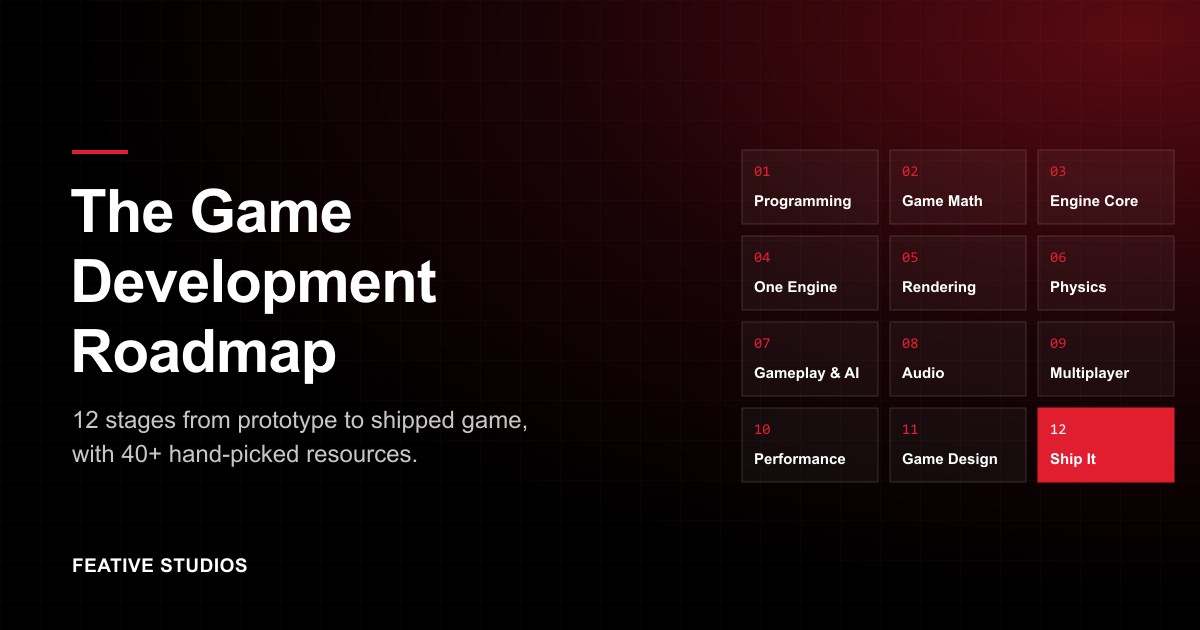
Here's a 12-stage roadmap to get there, with high-quality, mostly free resources for every step.
Stage 1: Programming Foundations
Every game is a real-time program with a hard deadline: about 16 milliseconds per frame. Strong fundamentals are non-negotiable.
- C++ or C#
- Data structures and algorithms
- Memory management
- Object-oriented and data-oriented thinking
- Game programming patterns
Resources
Stage 2: Game Math
Every jump, camera move and collision is math. You don't need a degree, but you do need to be fluent.
- Vectors and matrices
- Trigonometry
- Quaternions and rotations
- Interpolation and easing
- Coordinate spaces
Resources
- 3D Math Primer for Graphics and Game Development
- 3Blue1Brown: Essence of Linear Algebra
- Red Blob Games
Stage 3: Engine Fundamentals
Understand what happens between pressing a key and seeing the result on screen, and you'll debug in minutes instead of days.
- The game loop and fixed timesteps
- Entity Component Systems (ECS)
- Scene graphs
- Input handling
- Asset pipelines
Resources
- Gaffer On Games: Fix Your Timestep
- Game Programming Patterns: Game Loop
- Book: *Game Engine Architecture* by Jason Gregory
Stage 4: Master an Engine
Pick one and go deep. The concepts transfer; the muscle memory is what makes you productive.
- Unity, Unreal Engine or Godot
- Scripting and blueprints
- Prefabs, scenes and levels
- Editor tooling
- Build pipelines
Resources
Stage 5: Graphics & Rendering
Graphics is where games become beautiful, and where most frame budgets disappear.
- The rendering pipeline
- Shaders (HLSL and GLSL)
- Lighting and shadows
- Physically based rendering (PBR)
- Post-processing
Resources
Stage 6: Physics & Collision
Players forgive ugly art. They don't forgive falling through the floor.
- Rigid body dynamics
- Collision detection and response
- Numerical integration
- Raycasting
- Character controllers
Resources
- Gaffer On Games: Integration Basics
- Box2D Documentation
- Book: *Real-Time Collision Detection* by Christer Ericson
Stage 7: Gameplay Programming & AI
This is where mechanics come alive and enemies start to feel smart.
- Finite state machines
- Behavior trees
- Pathfinding with A*
- Steering behaviors
- Utility AI and GOAP
Resources
Stage 8: Audio
Sound is half of game feel, and the first thing players notice when it's missing.
- Sound effects and music systems
- Spatial (3D) audio
- Adaptive and dynamic music
- Audio middleware
- Mixing and performance
Resources
Stage 9: Multiplayer & Networking
Multiplayer multiplies everything: the bugs, the edge cases and the fun.
- Client-server architecture
- Client-side prediction
- Lag compensation
- Rollback netcode
- State replication
Resources
- Gabriel Gambetta: Fast-Paced Multiplayer
- Gaffer On Games: Networking
- Valve: Source Multiplayer Networking
Stage 10: Performance & Optimization
A great game that stutters is a bad game. Learn to measure before you optimize.
- CPU and GPU profiling
- Memory and garbage collection
- Draw calls and batching
- Level of detail (LOD) and culling
- Data-oriented design
Resources
Stage 11: Game Design & Player Experience
Code makes a game run. Design makes people want to keep playing it.
- Core gameplay loops
- Level design
- Game feel and "juice"
- Balancing and economy
- Playtesting
Resources
- GDC Vault
- Book: *The Art of Game Design* by Jesse Schell
- Book: *A Theory of Fun for Game Design* by Raph Koster
Stage 12: Ship Real Games
Finishing is a skill, and most developers never practise it. Small and shipped beats big and abandoned.
- A complete arcade clone with your own twist
- A platformer with polished game feel
- A small multiplayer game
- A game jam entry built in 48 hours
- A release on itch.io or Steam
Resources
The Bottom Line
Engines get you started. Fundamentals make you a game developer.
Great game developers understand math, rendering, performance and player experience. You don't need to master all 12 stages at once. Pick the stage where you feel weakest, build one small thing that uses it, and ship it.
Everything you need to start is linked above.
*At Feative Studio, this is how we approach every game and interactive experience we build. If you have a game idea that needs a team that can take it from prototype to launch, let's talk.*