
Technology · 4 min · 11/27/2026
The Backend Engineering Roadmap: 12 Stages Beyond CRUD
Frameworks get you hired. Fundamentals keep you valuable. A 12-stage backend roadmap, from databases to distributed systems, with mostly free resources.
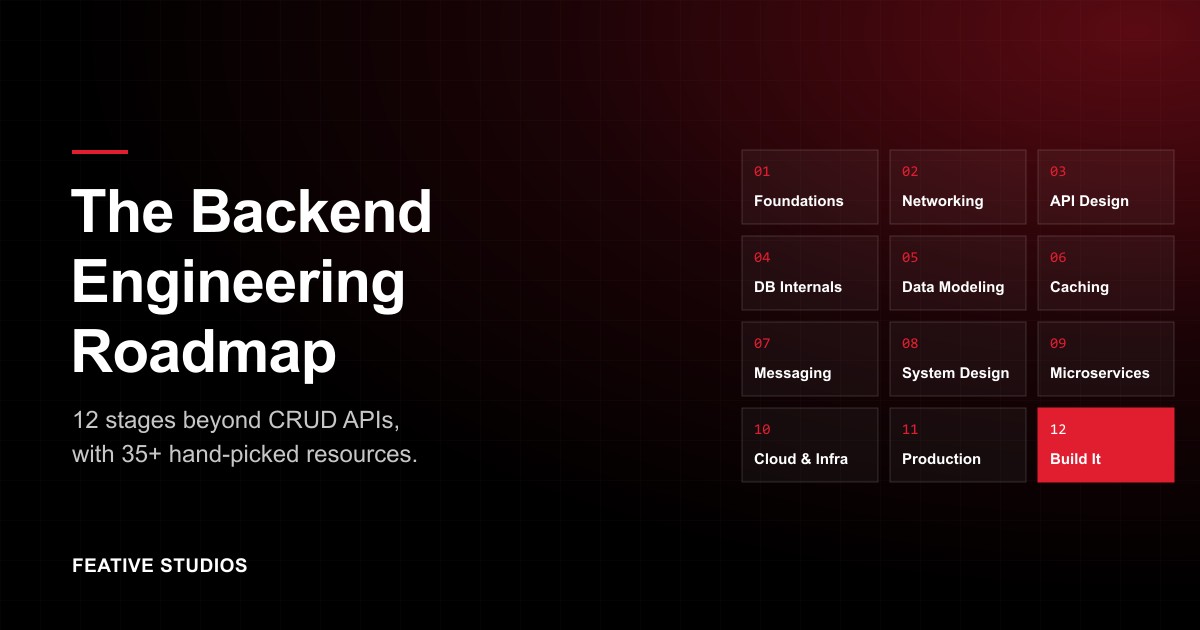
Most developers stop at CRUD. They learn a framework, wire up a few endpoints, connect a database, and call it backend engineering.
That's a starting point, not the destination.
The engineers companies fight to keep understand what happens *underneath* the framework: how data is stored, how packets move, how systems fail, and how to recover when they do. That knowledge doesn't go out of date when the next framework ships. It compounds.
Here's a 12-stage roadmap to get there, with high-quality, mostly free resources for every step.
Stage 1: Programming Foundations
Frameworks change. Fundamentals don't. Pick one strongly typed language and go deep.
- A systems-friendly language: C#, Java, Go or Rust
- Data structures and algorithms
- Memory management
- Concurrency
- Design patterns
Resources
- Teach Yourself Computer Science
- Refactoring.Guru: Design Patterns
- Operating Systems: Three Easy Pieces (OSTEP)
Stage 2: Networking & Protocols
Every request your API serves rides on these. When something is slow or broken, this is where the answer often lives.
- TCP/IP
- How HTTP really works
- TLS
- DNS
- REST, GraphQL and gRPC
Resources
Stage 3: API Engineering
An endpoint that works is easy. An API that stays safe, predictable and backward compatible for years is a craft.
- API versioning
- Authentication and authorization
- Rate limiting
- Pagination
- Idempotency
Resources
Stage 4: Database Internals
Most performance problems are database problems. Knowing how the engine thinks lets you fix them instead of guessing.
- Indexing
- B-trees and LSM trees
- Transactions
- Isolation levels
- Query execution plans
Resources
Stage 5: Advanced Data Modeling
How you shape data decides how far your system can scale before it needs a rewrite.
- Normalization
- Denormalization
- Partitioning
- Sharding
- Read replicas
Resources
- PostgreSQL Documentation
- MongoDB Manual
- Book: *Designing Data-Intensive Applications* by Martin Kleppmann
Stage 6: Caching Systems
Caching is the cheapest performance win there is, and one of the easiest ways to serve stale or wrong data.
- Redis
- Cache-aside
- Write-through
- Cache invalidation
- Distributed caching
Resources
Stage 7: Messaging & Async Processing
Not everything belongs in the request/response cycle. Queues keep systems responsive and resilient under load.
- Kafka
- RabbitMQ
- Azure Service Bus
- Background workers
- Dead-letter queues
Resources
Stage 8: System Design
This is where the pieces come together, and where senior engineers earn their title.
- Horizontal scaling
- Load balancing
- Service discovery
- CQRS
- Event-driven architecture
Resources
Stage 9: Microservices
Microservices solve organizational problems and create technical ones. Learn the patterns that keep them from turning into a distributed monolith.
- Service boundaries
- Saga pattern
- Outbox pattern
- Distributed transactions
- API gateways
Resources
Stage 10: Cloud & Infrastructure
Your code isn't done until it runs reliably somewhere other than your laptop.
- Docker
- Kubernetes
- Terraform
- CI/CD
- AWS, Azure or GCP
Resources
Stage 11: Production Engineering
Shipping is the beginning. Knowing what your system is doing at 3 a.m., and why, is what separates good engineers from great ones.
- Observability
- Distributed tracing
- Chaos testing
- SLOs and SLIs
- Performance profiling
Resources
Stage 12: Build Real Systems
Reading builds understanding. Building builds skill. Pick one project and take it all the way to production quality.
- A URL shortener
- A payment processing system
- A notification platform
- A distributed job scheduler
- A real-time messaging system
Resources
The Bottom Line
Frameworks get you hired. Fundamentals keep you valuable.
Great backend engineers understand databases, networks, concurrency and failure. You don't need to master all 12 stages at once. Pick the stage where you feel weakest and spend the next month there.
Everything you need to start is linked above, and almost all of it is free.
*At Feative Studio, this is the engineering mindset we bring to every product we build. If you need a backend that scales past the prototype, let's talk.*